



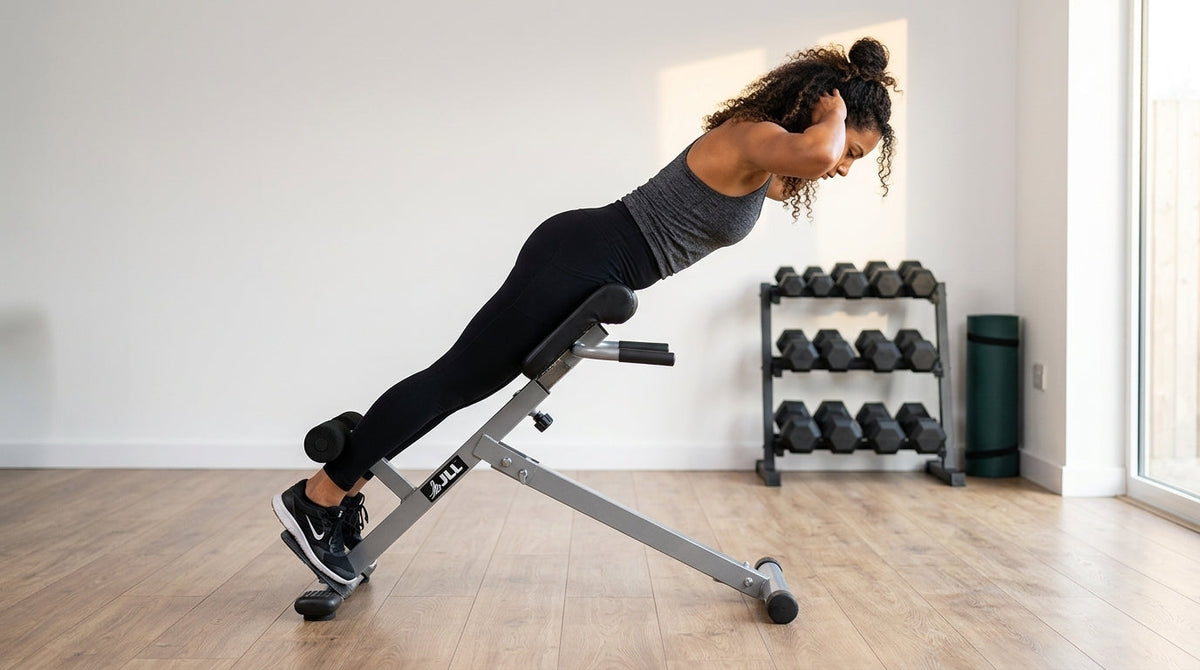
When it comes to bulletproofing the posterior chain, alleviating lower back stiffness, and forging deep abdominal control, few tools rival the hyperextension bench. Performing dedicated Roman-chair exercises builds functional strength across your entire kinetic chain—linking the hamstrings, glutes, spinal erectors, and deep abdominal wall into a resilient, cohesive unit that dramatically improves core stability.
Mastering the Roman chair allows you to safely build strength without placing heavy axial loads over your spine. By emphasising controlled muscle contractions through every repetition, you can systematically overload the posterior chain to prevent injury, reinforce posture, and promote long term athletic health.
- Target Muscles: Erector spinae, gluteus maximus, hamstrings, deep core wall, obliques
- Equipment Needed: 45-degree or 90-degree Roman chair (hyperextension bench)
- Optional Load: Cast iron weight plate or dumbbell
- Training Focus: Posterior chain hypertrophy, spinal decompression, core anti-flexion
What is a Roman Chair? (And Why It Belongs in Your Routine)
A Roman chair anchors your lower legs securely around the ankles and calves while suspending your upper body in free space. This unique leverage allows your hips to hinge through a deep range of motion under gravity while maintaining safety around each critical knee joint.

45 Degree Hyperextension Roman Chair
Target your lower back, glutes, and core with customisable hip pad heights, heavy-duty steel frame construction, and high-density supportive foam rollers.
Shop Roman Chair- Fascial & Muscular Synergy: Hyperextension drills load the interconnected layers of the thoracolumbar fascia, tying the lats and lower back together with the pelvis to optimise force transfer and everyday movement efficiency.
- Targeted Fibre Recruitment: The slow, deliberate eccentric phase engages fatigue-resistant type I and explosive type II muscle fibres across the hips and spine, ensuring balanced structural development.
- Postural Correction: Regularly training spinal extension and anti-rotation improves posture, counteracting the rounded shoulders and forward pelvic tilt caused by prolonged desk work.
- Protected Spinal Alignment: Working from a stable, neutral position minimises uneven disc compression across the sensitive lumbar vertebrae, keeping stress where it belongs—on working muscles.
Essential Roman Chair Exercises from Core to Glute
1. Glute-Biased 45-Degree Back Extension
Muscles Worked: Gluteus maximus, hamstrings, lower erectors
To shift mechanical load directly into each primary gluteal muscle rather than overloading the lower back, prioritise intentional pelvic positioning:
- Position the thigh pad below your hip crease so your pelvis can flex freely without restriction.
- Flare your feet outward at a 45-degree angle on the base plate to encourage external hip rotation and maximise glute fiber recruitment.
- Tuck your chin to your chest and maintain a slightly rounded upper back throughout the movement.
- Hinge forward from the hips until your hamstrings are fully lengthened.
- Drive your hips firmly into the support pad, squeezing your glutes hard to return your body to a straight line. Do not arch past neutral at the top.
2. Strict Lumbar Erector Extension
Muscles Worked: Erector spinae (iliocostalis, longissimus, spinalis), multifidus
This strict movement strengthens the deep spinal stabilisers that shield the lumbar vertebrae under heavy daily lifting tasks.
- Set the thigh support pad directly level with your hip crease, keeping your feet straight and parallel.
- Cross your arms over your chest or clasp your fingers lightly behind your head.
- Hinge forward with a flat spine until your torso forms a near 90-degree angle to your legs.
- Contract your lower back and spinal erectors to raise your upper body smoothly back to a neutral position.
- Pause briefly at the top to secure the contraction before lowering through a controlled 3-second descent.
3. Roman Chair Side Bends
Muscles Worked: Internal and external obliques, quadratus lumborum (QL), transverse abdominis
Lateral core strength is vital for stabilising the spine against unwanted shear forces and reinforcing overall core stability.
- Turn sideways on the bench, resting one hip on the pad with the outer edges of your feet locked under the foot rollers.
- Place your top hand behind your head and your lower hand across your abdomen to monitor muscle engagement.
- Lower your torso laterally toward the floor until you feel a complete stretch along the upper oblique.
- Initiate strong lateral muscle contractions to pull your torso upward, finishing just past parallel.
- Complete 10–12 controlled reps, then switch sides to maintain structural balance.

4. Roman Chair Isometric Superman Hold
Muscles Worked: Full posterior chain, posterior deltoids, deep core stabilisers
Static holds build endurance across the thoracolumbar fascia and postural muscles, teaching them to resist fatigue during demanding training sessions.
- Lock into the bench facing downward and lift your upper body until your torso forms a straight line from heels to head.
- Reach both arms forward overhead in a wide "Y" formation with your thumbs angled toward the ceiling.
- Brace your abdomen, squeeze your glutes, and draw your shoulder blades down and back.
- Hold this position for 30 to 45 seconds while taking deep, controlled diaphragmatic breaths.
Common Mistakes and Form Adjustments
- Hyperextending Past Neutral: Arching the lower back excessively at the top of a repetition pinches the facet joints of the spine and spikes the risk of injury. Always finish in a straight, neutral position.
- Incorrect Thigh Pad Height: Placing the support pad too high blocks natural hip hinge mechanics, forcing movement into spinal flexion instead of hip flexion. Adjust the pad 5-8 cm below the top of your pelvic bone.
- Using Momentum to Swing: Jerking your upper body upward reduces time-under-tension and stresses tendon insertions. A controlled tempo reduces the risk of strains and ensures maximum hypertrophy.

Frequently Asked Questions (FAQ)
Can Roman-chair exercises help alleviate lower back pain?
Yes, when performed with strict form and zero hyperextension. Strengthening the erectors, hamstrings, and glutes improves pelvic stability and reduces compensation in the lower back. However, if you are working through an acute disc injury, consult a qualified physiotherapist before introducing loaded spinal flexion.
How do I add resistance to Roman chair workouts?
Once you can complete 15 clean bodyweight reps, you can progressively overload by clutching a light cast iron weight plate or dumbbell against your chest, or by looping a light resistance band around the base frame.
What is the difference between a 45-degree and a 90-degree Roman chair?
A 45-degree bench creates a progressive resistance curve that peaks near the top of the extension, making it ideal for glute training and beginners. A 90-degree horizontal chair places maximum gravitational torque at the top horizontal position, placing higher demands on the hamstrings and lower back.
How often should I train on a Roman chair?
Because the posterior chain and core stabilisers are rich in endurance-oriented muscle fibers, performing 2 to 3 sessions per week (3 sets of 10–15 reps) provides an optimal stimulus to build strength, enhance posture, and protect spinal health over the long term.







Leave a comment
All comments are moderated before being published.
This site is protected by hCaptcha and the hCaptcha Privacy Policy and Terms of Service apply.