



Rowing Machine Jargon Guide
 Rower Types & Resistance Systems
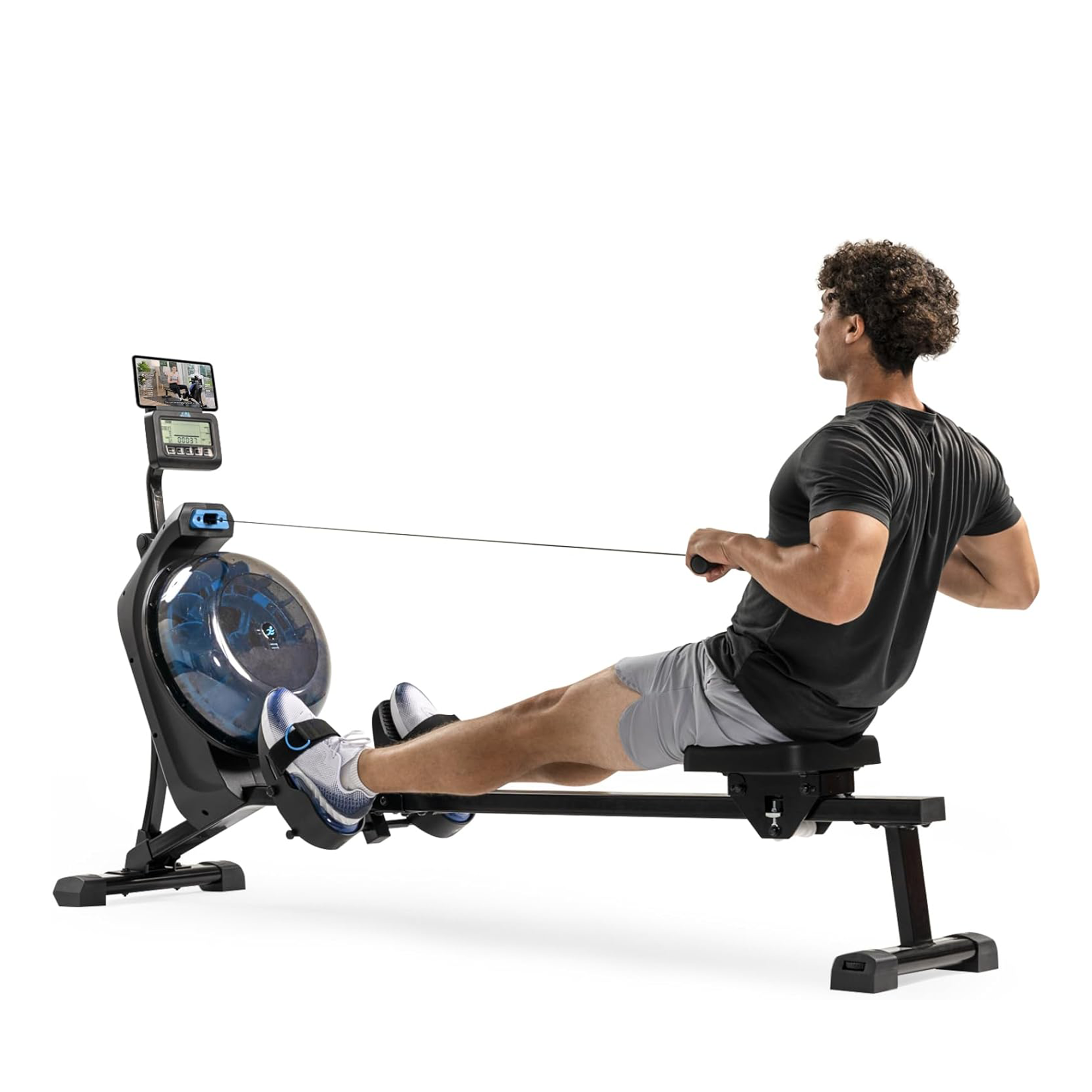
Rowing machines are categorised primarily by the method they use to create drag resistance against your stroke pull:
- The Stroke Pull (Drive Phase): The dynamic movement where you push through your legs and draw the handle toward your ribs to propel the flywheel.
- Drag Resistance: The opposing force (or braking power) generated inside the machine that makes pulling the handle challenging, mimicking the natural friction of moving a boat through water.
| Resistance System | How Resistance Is Generated | Acoustic Level | Stroke Dynamics & Feel |
|---|---|---|---|
| Air Rower | Spinning fan blades displace ambient air. Pulling faster creates exponentially greater drag force. | Loud (distinct airflow wind sound). | Accurately mimics real water rowing dynamics; standard choice for CrossFit and competitive training. |
| Water Rower | Internal paddles rotate within a sealed water tank. Faster pulls displace higher volumes of water. | Soothing acoustic rushing water sound. | Natural dynamic resistance with aesthetic wood or steel frame craftsmanship. |
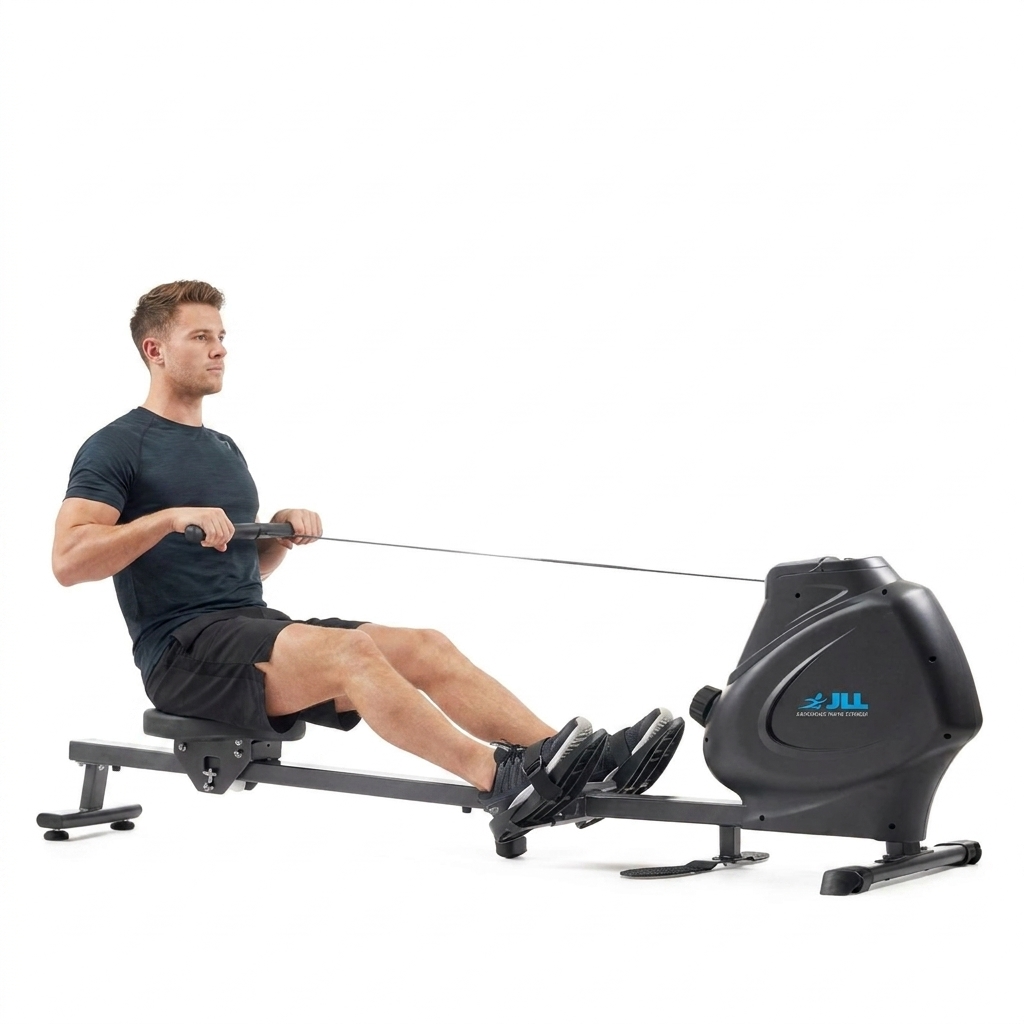
| Magnetic Rower | Electromagnets or permanent magnets adjust proximity to a heavy metal flywheel. | Near-silent. | Delivers linear, consistent resistance throughout the entire pull regardless of stroke speed. |
| Hydraulic Rower | Hydraulic piston cylinders attached to pivoting handles or arms. | Quiet to moderate. | Compact and affordable, though motion can feel mechanical and pistons may warm up over long sessions. |
Static vs. Dynamic Rowers
- Static: The machine frame and flywheel remain fixed to the floor while only the seat moves.
- Dynamic: The seat and the foot-stretcher/flywheel assembly both float and move dynamically, reducing the inertial strain on the lower back and simulating the movement of a boat beneath the rower.
- Rowing Slides: Accessory floor tracks that allow a static rower to glide back and forth dynamically during workouts.
 The 4 Phases of the Rowing Stroke
- The Catch: The starting position where knees are bent, shins are vertical, chest is tall, arms are extended forward, and the handle is ready to pull. A high-quality drive mechanism ensures an immediate "catch" with zero dead spots or slack in the pull ribbon/chain.
- The Drive: The power-producing phase initiated by full leg extension, followed by opening the hips, and finished with the arms pulling the handle to the lower ribs.
- The Finish: The end of the drive—legs straight, core angled back slightly at roughly 100°–110°, elbows drawn past the torso.
- The Recovery: The controlled return slide—arms extend forward, the torso pivots forward from the hips, and the knees bend to compress back toward the catch.
- Stroke Ratio (1:2): The pacing principle where the recovery phase should take approximately twice as long as the explosive drive phase to maximise mechanical efficiency and power generation.
 Resistance Controls & Internal Mechanics
Damper Setting (Air Rowers)
A lever mounted on the flywheel housing that adjusts the volume of air flowing into the fan cage (typically numbered 1 through 10):
- Lower Settings (1 – 4): Restricts airflow, simulating a lighter, faster racing shell on calm water.
- Higher Settings (6 – 10): Opens air vents completely, requiring more force to accelerate the flywheel (simulating a heavier boat).
💡 Buyer's Rule of Thumb: The damper setting is not a simple difficulty level. For efficient technique and long-term aerobic conditioning, keep the damper set between 3 and 5.
Drag Factor
An electronic metric calculated by the console that measures how quickly the flywheel decelerates between strokes. Drag factor accounts for atmospheric conditions, dust, and airflow, giving a standardised resistance measurement independent of the physical damper lever position.
Bungee / Shock Cord
The internal elastic return cord that tensions the drive axle and retracts the handle and chain smoothly during the recovery phase.
Drive Strap vs. Steel Chain
- Drive Strap: Multi-ply webbing (Kevlar or nylon) that operates silently.
- Steel Chain: Heavy-duty nickel-plated link chain offering maximum durability in commercial and multi-user environments.
 Frame, Monorail & Ergonomics
The horizontal or slightly angled track upon which the seat glides back and forth:
- Rail Material: Extruded aluminium or steel rails provide a smoother glide for seat rollers and support higher maximum user weights.
- Dual Rail vs. Single Rail: Dual-rail frames offer enhanced lateral balance, whereas single-rail frames reduce total machine weight.
- Catch-to-Seat Distance (Inseam Length): The total usable length of the monorail track, determining if taller athletes can achieve full leg extension without bottoming out.
- Foot Stretchers & Heel Cups: Adjustable footplates with instep/security straps engineered to stabilise footwear while enabling natural ankle flexion at the catch.
 Performance Metrics & Console Analytics
- /500m Split Time: The time required to row 500 metres at current power output; the universal pacing metric in rowing. Lower split times represent higher speed and power.
- Strokes Per Minute (SPM / Rating): Frequency of strokes completed per minute. Steady aerobic pieces typically sit at 20–24 SPM, while sprint pieces reach 32+ SPM.
- Force Curve: A live coordinate plot on the performance monitor mapping how smoothly and evenly power is applied from the initial catch drive through to the finish.
 Space & Storage Specifications
- Vertical Storage / Tilt Mechanism: Many water and magnetic rowing machines can be tipped upright on front wheels to rest vertically against a wall, occupying a tiny floor area (approx. 60 cm x 50 cm).
- Foldable Monorail: Frame hinge points that allow the slide rail to fold vertically or detach into two distinct sections for compact storage.
- Net Weight (N.W.) vs. Gross Weight (G.W.): Net weight measures the unboxed machine itself, while gross weight includes all shipping cartons and protective packaging.