

The Ultimate Guide to At-Home HYROX Training
HYROX is the world’s premier fitness racing series, a grueling competition that combines functional strength exercises with high-volume endurance running. A true hyrox workout is about mastering specific movement patterns while your heart rate is redlining - you are managing fatigue across eight distinct 1km runs, each separated by a functional workout station.
"Compromised running" is the heart of the sport. Unlike traditional strength training, which often isolates muscles in a controlled environment, a hyrox race requires your full body to work as a synchronized unit. Your legs will feel heavy, and your lungs will burn, but your aerobic engine must keep turning to maintain your pace between the grueling power stations.
While the event typically takes place in massive indoor arenas, you don't need a professional stadium to start. You can effectively build strength and stamina for a HYROX event at home with a bit of creativity and a solid training plan. Here is how to master the HYROX event structure and prepare your body for the start line.
1. Understanding the HYROX Event Structure
Before you start sweating, you need to know the beast you’re fighting. The HYROX event structure is a relentless loop: a 1 km run followed by one functional workout station, repeated eight times. At home, your goal is to simulate this "compromised running"—the feeling of trying to sprint when your legs feel like blocks of wood. To succeed, you must move through these transitions with a high heart rate while maintaining technical proficiency. The stations are:
- Ski Erg
- Sled Push & Sled Pull
- Burpee Broad Jumps
- Rowing
- Farmers Carry
- Sandbag Lunges
- 100 Wall Balls

2. Essential Equipment for At-Home HYROX Training
To mimic the movement patterns of the race, you don’t need a full gym, but a few key tools will help you build muscle and simulate the resistance of the sleds:
Kettlebell or Dumbbells: Vital for strength workouts, farmer’s carries, and goblet squats.
Resistance Band: Perfect for simulating sled pulls or adding tension to functional movements.
Sandbag or Weighted Backpack: Essential for sandbag lunges and mimics the awkward loads found in daily life.
Medicine Ball: Used for the notorious wall balls station.
Treadmill Running: If you have one, use it to practice "interspersed" running between strength sets.

3. Sample At-Home HYROX Training Program
A successful hyrox training program must balance aerobic capacity with the ability to perform functional exercise under fatigue.
Warm-Up (10 minutes):
Jump Rope or Jog: 3 minutes to elevate the heart rate.
Dynamic Stretches: Focus on full body mobility (leg swings, arm circles).
Activation: 10 air squats and 10 push-ups to prep multiple muscle groups.

4. Run and Functional Exercise Circuits
This circuit-based workout routine mimics the "compromised running" you will face on race day.
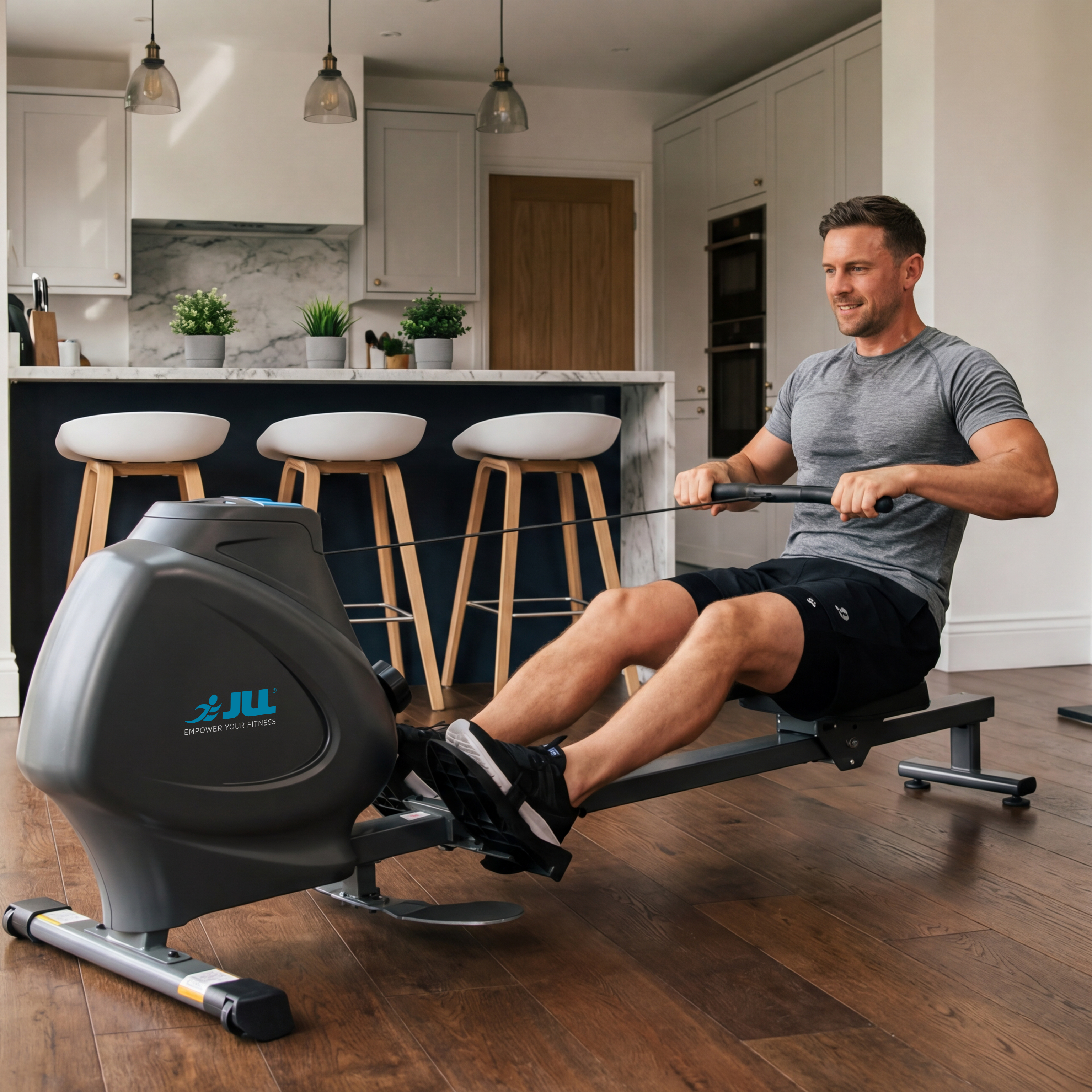
Circuit 1 (Ski Erg Simulation): 1 km run + 50 resistance band pull-downs.If you can’t get to a Ski Erg, a Compact Full-Motion Rowing Machine is a fantastic full body alternative that hits multiple muscle groups and keeps your heart rate high.
Circuit 2 (Sled Push Simulation): 1 km run + 40 seconds of "towel pushes" on a smooth floor to build explosive functional strength.
Circuit 3 (Burpee Broad Jumps): 1 km run + 20 meters of burpee broad jumps. Focus on a consistent broad jump distance to stay efficient.
Circuit 4 (Rowing Simulation): 1 km run + 1 minute of seated resistance band rows. By anchoring Resistance Bands to a sturdy post, you can perform resisted bear crawls or rows. This builds the specific functional strength needed for the heavy power stations.
Circuit 5 (Farmers Carry): 1 km run + 200m carry with your heaviest dumbbells. Using JLL Cast Iron Dumbbells, you can perform strength workouts that focus on movement patterns used in the race. This builds strength for everyday activities like carrying heavy groceries.
Circuit 6 (Sandbag Lunges): 1 km run + 20 walking lunge repetitions per leg with a sandbag. This targets single leg stability. If you don't have a sandbag, sandbag lunges can be effectively replicated with a JLL Weighted Vest or a heavy JLL Kettlebell held in a goblet position. These moves test your core stability and unilateral power, which are vital for daily life.
Circuit 7 (Wall Balls): 1 km run + 100 wall balls (or as many as possible). Ensure you hit the full squat depth before you return to the starting position. This is the ultimate "closer" of the race. Use a JLL Medicine Ball or Wall Ball against an outside wall. Focus on the squat depth and ensure you return to the starting position with control on every rep to maximize health benefits.
5. Modifications for Small Spaces
If you can't run outdoors, you can still maintain the high intensity required for hyrox events:
Treadmill Running: If you have one, use it for intervals. Run 1km at your target race pace, then hop off and do 20 burpees.
High Knees/Mountain Climbers: If you don't have a treadmill, use a local park. The key is to keep your heart rate high during the transitions between running and strength workouts. Do these for 4–6 minutes to keep the heart rate in the same zone as a 1km run.
To nail the cardio element, treadmill running is your best friend. A high-performance treadmill, like the Helius Lite Smart or Pegasus Connected Folding Treadmill, allows you to accurately track your 1km runs and simulate the intensity of the race carpet from your garage or spare room.

6. Incorporating Strength Workouts
Unlike traditional strength training that focuses on isolated muscles, a HYROX workout hits multiple muscle groups at once. This full body approach has massive health benefits and improves how you handle everyday movements. By focusing on movement patterns rather than just "bicep curls," you build muscle that is functional and resilient. Your strength workouts should focus on:
Compound Lifts: Squats and deadlifts that engage multiple muscle groups.
Balance and Coordination: Moves that challenge your stability, providing long-term health benefits and injury prevention.
Core Stability: Planks and carries to support your spine during heavy functional movements.
7. Weekly Training Plan
To see real results before your target race, aim for 4–5 training sessions per week to see the best results:
Day 1: A full simulation. Run 1km (or 5 mins of high knees), then do a functional exercise station. Repeat 4 times.
Day 2: Focus on unilateral power. Single-leg squats, walking lunge sets, and overhead presses.
Day 3: Rest or active recovery (focus on balance and coordination through yoga).
Day 4: High-intensity interval training (HIIT). 30 seconds of burpee broad jumps, 30 seconds rest.
Day 5: Heavy carries. Grab two heavy water jugs and walk for 400m. This is great for everyday life prep.
Day 6/7: Rest and recovery.

8. Recovery and Health Benefits
The benefits of functional fitness go beyond the podium. By training everyday movements, you improve your quality of daily life.
Nutrition: Increase protein to build muscle and repair tissues.
Recovery: Use a foam roller to maintain the health of your movement patterns.
Consistency: Following a structured hyrox training program leads to massive cardiovascular and metabolic health benefits.
9. Progress Tracking
Don't just train—measure. Log your times for each 1 km run and track the weight used in your functional strength exercises. Every 4 weeks, perform a "Simulated Race Day" to see how your at-home hyrox training is paying off.
One piece of advice: don't sacrifice form for speed. Whether you are doing wall balls or broad jumps, quality of movement prevents injury. Functional fitness offers incredible health benefits, but only if you respect the movement patterns.
Why Functional Training Matters for Everyday Life
One of the greatest benefits of functional fitness is how it translates to everyday life. Whether it's carrying heavy groceries, playing with your kids, or moving furniture, the functional strength you develop in a HYROX training plan supports all everyday activities.
It builds strength that protects your joints and ensures you stay mobile and capable in your daily life. By diversifying your workout routine to include both high intensity cardio and full body lifting, you'll be ready for whatever everyday movements or competitive hurdles come your way
Training for hyrox events at home is entirely possible with a bit of grit. By focusing on functional movements that mirror everyday life, you'll arrive at the start line stronger, faster, and ready to conquer the course!
Whether you are a seasoned pro or a first-timer, remember: fitness racing is as much about mental grit as it is physical prep. Stay focused, stick to your pacing, and embrace the grind!






Leave a comment
All comments are moderated before being published.
This site is protected by hCaptcha and the hCaptcha Privacy Policy and Terms of Service apply.