




When building a high-performance home gym, most lifters rush to choose their free weights or load up a shopping cart with heavy weight plates. But there is a silent anchor to your entire strength routine that requires just as much consideration: your weight bench.
A high-quality gym weight bench provides the structural foundation for your entire training regime. A sub-par, shaky bench will shatter your lifting confidence, limit your raw power output, and dangerously compromise your bar path under a heavy load. Conversely, the right platform unlocks hundreds of secure, muscle-building angles while keeping your training safe.
So, how to choose a weight bench that perfectly matches your space, lifting style, and long-term targets?
Whether you are browsing a weight bench for sale online or outfitting an elite garage setup, this comprehensive buyer’s guide breaks down the essential technical specs, distinct bench styles, and premium options available at JLL Fitness to help you make an informed decision.

1. Frame Material & Real-World Weight Capacity
The single most critical safety specification you must check before purchasing weight benches for home gym use is the maximum weight capacity. This rating isn't just the amount of iron you can load onto a barbell—it is the combined total of your maximum lifting load plus your physical body weight.
- The Baseline Safety Standard: A good home bench should feature a heavy-duty workout bench design with reinforced steel frames (ideally 12-gauge steel or thicker) and should support at least 200 kg.
- The Build Quality Indicator: Weight capacity serves as a direct indicator of craftsmanship. Selecting an adjustable weight lifting bench with a high-capacity frame dramatically drops your risk of structural warping over time. It ensures you can focus entirely on weight lifting at home and push close to failure without safety concerns.
2. Flat Benches vs. Adjustable Benches
Your training methodology and aesthetic goals dictate whether you should opt for a fixed, flat platform or an adjustable bench press station.
The Flat Weight Bench
A flat weight bench is simple, compact, and completely rigid. Because it has zero moving parts or adjustment hinges, it inherently offers maximum structural stability.
- Best For: Powerlifters focused purely on heavy flat chest presses, barbell rows, and explosive bodyweight movements like box step-ups or tricep dips.
The Adjustable Bench Press Station
An adjustable exercise bench features a split-pad design mounted on a secure ladder or pin adjustment system. Often referred to as a FID bench (Flat, Incline, Decline), this is widely considered the best adjustable solution for versatile home training.
- Best For: Hypertrophy-focused lifters and bodybuilders looking to consistently build strength across the entire body. Shifting the angle of the pad allows you to isolate specific muscles with surgical precision across diverse weight training movements:
3. Pad Width, Cushioning, & Density
A specification that many home gym lifters overlook until their first training session is the padding design.
- Pad Width: A standard pad should measure between 28 to 30 cm (11 to 12 inches) wide. If a pad is too narrow, your shoulder blades will hang off the edges, making it impossible to retract your scapula and lock in a stable base during a heavy dumbbell press.
- Foam Density: Avoid cheap padding where your back sinks straight through to hit the underlying frame. Look for medium-firm, high-density foam wrapped in sweat-resistant, non-slip PU leather upholstery to ensure maximum comfort and structural support.
4. Footprint, Space Constraints, & Portability
Before pulling the trigger on a new folding gym bench, always measure your active floor space. Remember that you need a perimeter clear zone for your arm span during dumbbell reverse flyes and the total length of your bar.
If you are training in a dual-purpose room, such as a compact bedroom or a living room corner, choosing a folding weight bench or a collapsible weight bench is an absolute game-changer. A high-quality fold away workout bench allows you to roll the machine out for an intense session and stow it flat against a wall when finished.
The B200 Adjustable Weight Bench
If you want to experience the rock-solid stability of commercial gyms inside an elegant, home-conscious footprint, the JLL B200 Adjustable Weight Bench checks every single box for safety, portability, and utility.
Engineered for Premium Home Performance:
- Robust 200kg Load Rating: Built with a heavy-duty steel frame, the B200 provides a rock-solid, wobble-free foundation designed to support heavy lifting weights without compromising safety.
- 7-Level Angle Adjustment: Featuring a 7-level backrest adjustment ladder, this adjustable exercise bench transitions smoothly from a flat chest press to a steep overhead dumbbell shoulder press to hit every angle of your torso.
- Premium Ergo-Padding: Wrapped in commercial-grade leather upholstery, the dense foam cushioning keeps your spine protected under load while preventing slippage during high-volume sets.
- Smart Folding exercise bench Architecture: Designed with convenient integrated front transport wheels and a built-in handle, it functions as a premium folding gym bench that you can effortlessly maneuver to reclaim your room's floor space in seconds.

The Ultimate Strength Workout
To show you just how versatile a heavy duty workout bench can be when paired with a set of adjustable dumbbells, here is a classic muscle-building superset you can execute right at home:
Exercise A: The Seated Overhead Dumbbell Shoulder Press
- Set your adjustable weight lifting bench to a steep incline (around 85 degrees).
- Clean your dumbbells up to shoulder height with your palms facing forward.
- Keep your feet pressed firmly into the floor and brace your core tightly against the pad.
- Press the weights straight up overhead in a fluid arc until your arms are fully extended, then lower them smoothly back to shoulder height.
Exercise B: The Incline Bicep Curl
- Drop the backrest of your adjustable bench press down to a 45-degree incline.
- Sit back with a dumbbell in each hand, letting your arms hang straight down toward the floor.
- Turn your hands so you are holding the weights with your palms facing forward.
- Keep your elbows locked in a fixed position and execute a controlled bicep curl, squeezing the muscle tightly at the peak of the contraction before lowering the weight under control.
The SunnyFit App
To help you reach your physical targets over the long term, pair your weight benches for home gym workouts with the SunnyFit App. This completely free digital platform removes the confusion from building independent programs by serving up over 2,000 on-demand fitness video courses led by expert personal trainers.
Whether you want to try structured dumbbell workouts, step-by-step strength training protocols, or targeted upper-body conditioning, the app provides full visual guidance to perfect your form, log your workout history, and keep you completely accountable as you build real muscle mass.
- Download for iOS on the Apple App Store
- Download for Android on the Google Play Store

Frequently Asked Questions (FAQ)
Can I use an adjustable weight bench inside a squat rack or power cage?
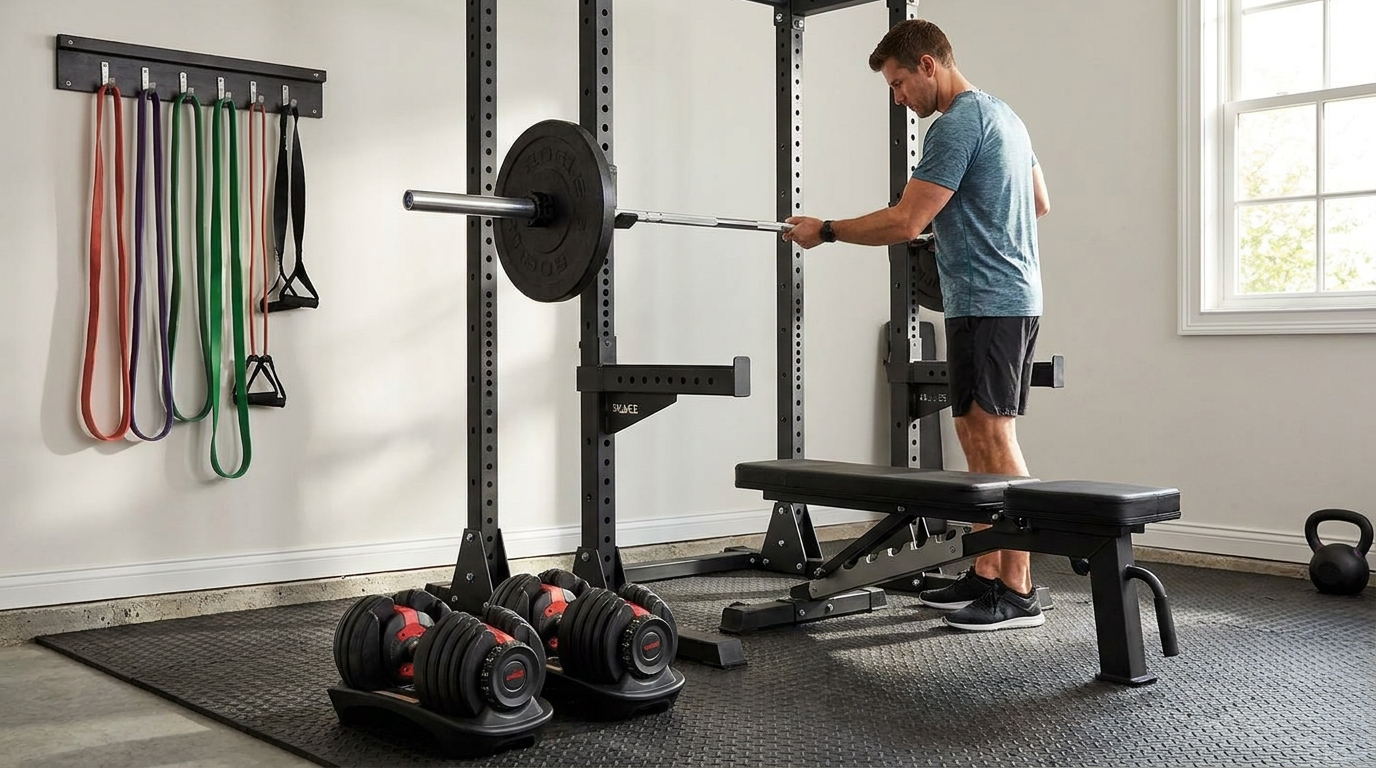
Yes, absolutely! In fact, pairing an adjustable bench like the JLL B200 with a heavy-duty barbell squat rack is the ultimate way to safely perform incline and flat barbell bench presses at home. Just ensure you center the bench accurately within the rack so the bar lands perfectly on the safety spotter arms if you hit mechanical failure.
Is a folding exercise bench stable enough for heavy weightlifting?
As long as the bench is engineered with high-grade steel and features a secure, heavy-duty locking pin or ladder system (like the JLL B200), a folding weight bench is incredibly stable and fully capable of handling intense compound lifting up to its specified 200kg maximum weight load.
How do I prevent injuries when bench pressing alone at home?
When training by yourself without a human spotter, you must always maintain control over your lifting tempo. Never lift to absolute failure on a barbell setup unless you are training inside a cage with properly adjusted safety bars. If you are using dumbbells, ensure you practice safe clearing mechanics—dropping the weights safely to the sides onto thick rubber gym flooring if you cannot complete a repetition.




Leave a comment
All comments are moderated before being published.
This site is protected by hCaptcha and the hCaptcha Privacy Policy and Terms of Service apply.